











Ever feel like you and your spouse are just coexisting instead of truly connecting? You’re busy, life is full, and somehow the two of you keep missing each other — not dramatically, just quietly. That slow drift is real, and it’s more dangerous than most couples realize.
In this solo episode of the One Degree Marriage Podcast, we’re breaking down 7 practical, research-backed habits that deeply connected couples practice. These aren’t lofty concepts — they’re small, repeatable actions you can start today that compound over time into a marriage that feels genuinely close.
Whether you’re in a disconnected season or just looking to go deeper, there’s something here for you.
📌 FREE resource: Download the Weekly Marriage Meeting™ Template
What You’ll Learn from This Episode:
- Why the “High-Low-Buffalo” daily check-in creates deeper connection than asking “how was your day?”
- The Gottman-backed physical touch habit that takes less than 10 seconds
- How to build a conflict plan that actually brings you closer instead of leaving damage behind
- Why specific gratitude is more powerful than general appreciation
- The slow drift warning signs most couples miss until it’s too late
Habit 1: The Daily Check-In (High-Low-Buffalo)
One of the simplest and most powerful habits a couple can build is a daily check-in. It doesn’t have to be long or formal — the goal is to create a consistent moment each day where you actually share what’s going on inside.
The format we love and personally use is the High-Low-Buffalo:
- High — the best part of your day, a praise, or something you’re grateful for
- Low — the hardest part of your day; something worth praying over together
- Buffalo — something totally random: a funny moment, something you learned, an article you read
The Buffalo is the secret weapon here. It forces you to share something you probably wouldn’t have mentioned otherwise — and that’s exactly where connection hides. If your spouse is struggling to think of one, ask a prompt: “What’s something interesting you read today?” or “What made you laugh?”
Beyond connection, the high-low-buffalo builds a habit of reflection — slowing down enough to actually process your day before powering on to the next one.
💡 Quick start: Try this tonight at dinner or before bed. It takes 5–10 minutes and costs nothing.
Habit 2: Non-Sexual Physical Touch
Physical touch is one of the most underrated connection tools in a marriage — especially when life gets busy or tension creeps in. We’re not talking about intimacy in the bedroom. We’re talking about the everyday stuff:
- A real hug before one of you leaves for work
- A shoulder rub after a hard day
- A six-second kiss — longer than a peck, more intentional than a habit
That last one comes from research by Dr. John Gottman, who found that a six-second kiss is long enough to be meaningful and to interrupt whatever else is going on. It’s a tiny act that says: I see you. I’m here. We’re good.
There’s real science behind this, too. Physical touch releases oxytocin — the bonding hormone — which naturally reduces stress and increases feelings of closeness. Even if it feels like hugging a brick wall in a tense moment, research (and lived experience) shows that it still works.
💡 Marriage tip: Make a six-second kiss part of your goodbye routine. It’s short enough to never skip, and meaningful enough to actually matter.
Habit 3: Pray Together
This one is simple to say and surprisingly hard to do consistently — even for couples who are both deeply committed in their individual faith lives.
Studies on couples who pray together show dramatically lower divorce rates. While there are multiple factors at play, the act of praying together creates a posture of shared humility — you’re both coming before God together, not as individuals. That reorientation does something to a marriage.
Praying together also means voicing your actual fears, needs, and gratitude out loud in front of your spouse. That vulnerability alone builds intimacy. And when you declare dependence on God as one — as the two having become one — it cements something that no date night or communication exercise can replicate.
If you and your spouse haven’t been praying together regularly, start small. One minute. One sentence each. Tonight.
Habit 4: The Weekly Marriage Meeting™
If there’s one habit on this list that can change the entire trajectory of your marriage, this is it.
The weekly marriage meeting is a structured, intentional check-in — not a conflict session, not a to-do review, but a dedicated time to assess how your marriage is actually doing across every major area of life.
What does a Weekly Marriage Meeting™ look like?
A meeting typically runs 30–45 minutes and covers:
- High-Low-Buffalo of the week
- How did we serve each other well this past week?
- How can I best serve you in the week ahead?
- Check-in on intimacy, finances, and other key pillars
- Review of your family mission statement
- Assessment of your core values — how did we live them out? Which one needs focus this week?
- Closing prayer and shared prayer requests
We’ve been doing this for over seven years. The format has evolved slightly, but the structure has stayed consistent — and that consistency is what makes it work. What you return to regularly is what actually shapes your marriage.
📥 Get the free template: A printable version of the full Weekly Marriage Meeting™ is available at onedegreemarriage.com/meeting — just enter your email, and it will be sent to you.
Habit 5: Express Specific Gratitude
Gratitude is one of the most powerful tools in a marriage, but only when it’s specific.
There’s a big difference between:
- “I appreciate how hard you work.” (general, forgettable)
- “I noticed you got up with the baby last night because you knew I needed sleep. That meant a lot to me.” (specific, memorable)
Specific gratitude does two things. First, it tells your spouse that you’re actually paying attention. Second, it trains your own brain to look for good things — and what you look for gets amplified.
There’s a simple rule to live by: if you think a good thing about your spouse, say it. Out loud. Right then. Don’t let it go unspoken because you figure they already know or it’s not a big enough deal. Say it.
Over time, this one habit reshapes how you see your spouse — from someone you live with, to someone you’re actively rooting for and grateful for.
💡 Try this today: Send your spouse one specific, detailed appreciation text right now. Name exactly what they did and why it mattered to you.
Habit 6: Protect Your Marriage From Slow Drift
This might be the most underestimated threat to modern marriages: not a blowup, not a betrayal — just a slow, quiet drift apart.
Here’s how it sneaks in: You’re both good people. You’re going to church, raising your kids, busy and tired. And slowly, without realizing it, you start giving each other your leftovers instead of your best.
How to protect against slow drift in your marriage:
- Audit your attention — are your phones down at dinner?
- Make small moments intentional — stand together while making dinner, and do your high-low-buffalo instead of being in separate rooms
- Protect margin in your schedule for each other — one family date a month, even simple ones
- Use your Weekly Marriage Meeting™ as an early warning system
Date nights are great, but they’re not a cure-all. Connection happens in the accumulated weight of small moments, and that’s actually good news, because small moments are everywhere. You don’t need a babysitter to have a meaningful conversation.
This is the whole idea behind One Degree: small, consistent shifts that compound into a dramatically different destination. The drift is gradual, and so is the return.
💡 One action: Identify one “low-grade drift” in your marriage right now — phones at dinner, separate evenings, no check-ins — and address just that one thing this week.
Habit 7: Fight Well—Have a Conflict Resolution Plan
Most couples have no plan for conflict. So every argument feels like a crisis, leaves damage behind, and ends with both people feeling more distant than before.
But conflict isn’t the enemy of connection — it can actually deepen it, when handled well. If two people are both honestly voicing their perspectives, some disagreement is inevitable and healthy. The goal isn’t zero conflict. The goal is conflict that brings you closer.
A simple conflict plan that works:
- Stop — pause the escalating conversation before it goes somewhere harmful
- Pray — together if possible, individually if needed. It’s nearly impossible to stay inflamed when you’re standing before God together
- Remind each other you’re on the same team — say it out loud: “We’re on the same team.” It sounds simple. It works
- Each person names their main issue — not a list of grievances, just the one core thing bothering them right now
- Practice active listening — repeat back what you heard and ask: “Did I understand your perspective?”
Some of our most connecting moments as a couple have come out of conflicts that followed this plan. Instead of leaving neutral or bruised, you often end up closer than you were before the argument started.
And don’t underestimate the power of a real apology. Saying “I’m sorry, I shouldn’t have spoken to you that way” — and meaning it — is one of the most direct routes to intimacy. It takes humility. It gets easier the more you practice it.
The 7 Habits at a Glance
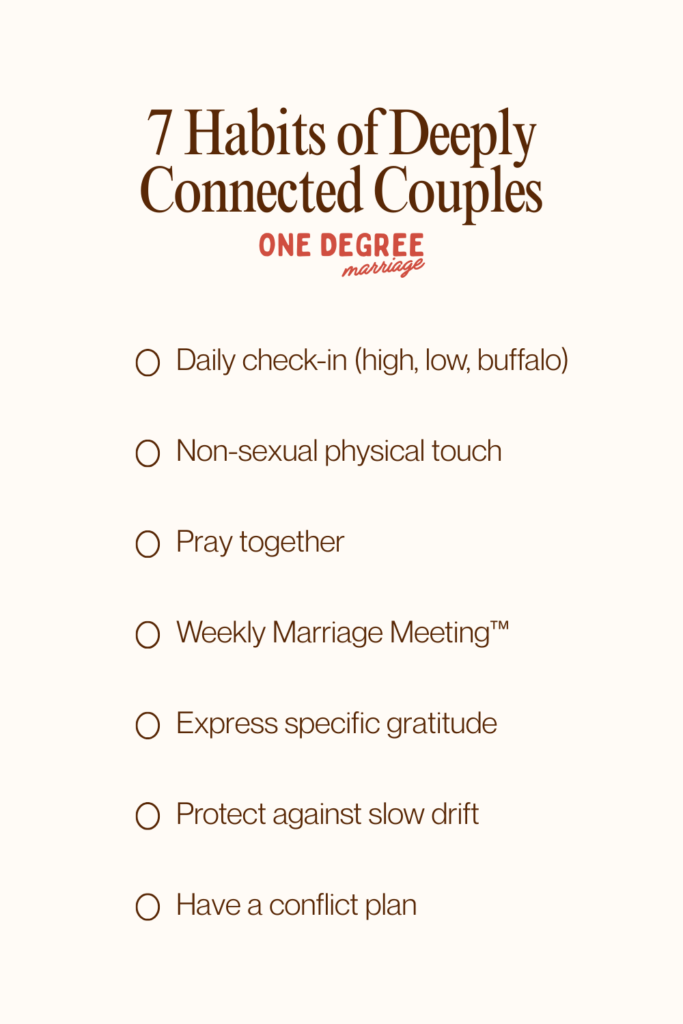
- Daily Check-In (High-Low-Buffalo)
- Non-Sexual Physical Touch
- Pray Together
- Weekly Marriage Meeting
- Express Specific Gratitude
- Protect Against Slow Drift
- Fight Well — Have a Conflict Resolution Plan
These habits aren’t a checklist to crush or a way to grade yourself. They’re small, sustainable shifts that — practiced consistently — build the kind of marriage where both people feel seen, appreciated, and genuinely connected.
Start with one. Or two. Pick the one that jumped out at you and bring it into your marriage this week.
Resources Mentioned
- Free Weekly Marriage Meeting Template
- Gottman Institute — Six-Second Kiss research
- Weekly Marriage Meeting Journal™


About The One Degree Marriage Podcast
The One Degree Marriage Podcast is hosted by a husband-and-wife team dedicated to helping couples build deeply connected, intentional marriages — one small shift at a time. The show covers everything from communication and conflict to faith, finances, and the rhythms that make a marriage thrive.
New episodes drop weekly. Subscribe wherever you listen to podcasts.
You don’t have to figure marriage out alone. At One Degree Marriage, we help couples build intentional connection one small shift at a time. Start with our free Weekly Marriage Meeting Template — or grab the full journal to go deeper.
Read the full transcript
One Degree Podcast (00:00.63)
What is up, One Degree Fam? It is so strangely just me today, which I feel like is so ironic for our marriage podcast. But actually, Nathaniel was just sitting next to me and then he this work thing come up. And if we’re being real life here, there is just not another time before this is going to be posted that we will be able to not have kids running around in our house and also it not be like past very late at night. We just have a lot of things coming up in the rest of the week. So.
I was like, you know, cause we were like, okay, we’ll record. I said, you know, I could record alone. I was like, okay, we’re gonna do this. I, are probably, we’re certainly not gonna have as much chit chat today. I really, thankfully this is going to be a very, it was intended to be a very pragmatic, practical, tangible, you know, just get in there, give you some good tactical, how many more describer, descriptive words can I give you?
Just some very practical takeaways that you can hopefully you’re listening and there are a few that are like, ooh, that is good. Like that one is something that I really wanna do to invest in my marriage this week and today. that’s something I didn’t even realize. Like I so often have this habit of drinking water when Nathaniel’s talking. You’re just gonna have to have some pauses today. anyway, we’re gonna be talking about, I’m going to be talking about by we, I mean me, seven habits.
deeply connected couples seven things that you can focus on in your marriage or pick one or two to focus on in your marriage in order to go deeper in your connection whether it feels like you are just missing each other and there’s just really a lack of connection there or You there’s always room for growth. You know, there’s just you’re feeling good generally speaking, but there’s room to connect more deeply there’s room to
Yeah, just appreciate each other more and express that more. So let’s dive into it without further ado. Habit number one, having a daily check-in. If you’ve been around these parts, you know that we personally, ours looks like a high-low buffalo. So we share at any point in the day, but generally, generally I would say closer to bedtime, our high of the day, something good that happened. Yeah.
One Degree Podcast (02:27.352)
pretty self-explanatory, our low of the day. The worst thing that happened, something I’m thinking high that happened could be like a praise, like thank the Lord for this. And so sometimes it’s something very simple of like, just felt a lot of peace today or I was able, I mean, I was able to get a nap or I was, that never happens, but whatever it is, low is something I think that has a secondary benefit of sharing something that we can be praying for, for each other of.
This was really hard or this thing happened or whatever. Buffalo, my personal favorite, it’s just something totally random. So it can be something funny that happened, something you learned. Sometimes my issue with Nathaniel personally, no, my issue that is my own personal issue that I run into with Nathaniel is I share all the things all the time. Like I, in general, if you know me, I’m just like a word vomit.
Like I will say things even if there’s just, whatever, that’s just how I roll. So I like spew Buffalo’s all the time. And so when it comes time for Buffalo, I’m like, the pressure’s on to like think of something I haven’t already said and I’ve said it all. Nathaniel often will be like, I don’t have a Buffalo. And then he’s a big like, he’s not a social media person at all, but he is a big like newsreader, like Kurt, like yahoo.com. I’m like, literally how old are you? In the sense that I would feel like he’s like, he is the
internet habits of a 65 year old, but he’ll like be on Yahoo.com reading all these random articles. And so I’m like, tell me something you’ve read today. That’s like a good Buffalo. And it usually prompts something good. whatever that is for your spouse, prompt the Buffalo if they are struggling to think of something or I really liked the something funny that happened, especially if you work outside the home, your spouse works outside the home, there’s something that happened during the day or like maybe it’s not funny, but something that you wouldn’t think to tell your spouse.
if you weren’t prompted to, and that is a good tie up for this. That is the point of a high-low buffalo. So yes, sharing your high and low, but I think it forces you, it has these extra benefits of forcing you to reflect on the day and not just like power through and always go on to the next day and to rack your brain for something that you might not otherwise share, which inadvertently creates deeper connection. And so yeah, that’s habit number one. Have a daily check-in, do your high-low buffaloes. Habit number two,
One Degree Podcast (04:53.272)
Half physical touch, that isn’t sexual. Half physical touch, that is sexual, shoot. But something really practical that maybe people just forget about, maybe, if you’re feeling disconnected, is the power of just giving each other a hug and a kiss before one of you leaves for work or both of you leave for work, or just the back rub, shoulder rub, those kind of things are, they’re intimate, you know? They’re not sexually intimate necessarily, but they are intimate and they’re a very good way, I think.
For me, I see when we are just like tense, either tense at each other, or I can tell that Nathaniel’s just had a rough day or he’s frustrated about some situation. A hug is so disarming, even if it feels like hugging a brick wall because like there’s a little bit of pride there or I’m throwing him under the bus and he’s not even here to defend himself. Whatever it is, it goes both ways. Sometimes I’m that. Whatever, or he’s just like,
It wasn’t immediately, it didn’t immediately soften him. I’m still hugging a brick wall, but he will say after the fact or he’ll say sometimes of like, I just really appreciate when you do that. Like it is very, it is comforting and disarming. And I appreciate it for him. Like anytime that he’ll give me, you know, just a, just a good old hug. So I think it’s just a, again, very simple way. I mean, there’s science, it releases oxytocin. There’s like a whole chemical bond there of the importance of physical touch.
But yeah, commit to good old hug, six second kiss, think that’s a Gottman study thing. I mean, cause six seconds, like that’s more than a peck, obviously. It’s like a little awkward, not, I mean, it’s like, we’re not making out, like you’re about to leave, but it’s a little more than a peck. Anyway, that’s a six second, the six second kiss thing is the thing. I think if you Google it, I’m pretty sure it’s Gottman, the Gottman research Institute that did that. So.
Habit number one, Hilo Buffalo. This is me trying to channel Nathaniel. He’s really good about like recapping. It’s not like seminary training in him. I’m usually like power onto the next one without recapping. Habit number two, physical touch that isn’t sexual. Habit number three, praying together. We talk about this, we’ve had episodes about this, the importance of praying together. There are statistics about couples who pray together and the divorce rates plummeting. I think that’s for so many reasons. One, they’re connecting on this level. Two, there’s probably a shared faith there. You know, there’s lots to unpack there.
One Degree Podcast (07:18.402)
But I would say even Christian couples, even very independently solid Christian couples, like you’re both walking with the Lord deeply, I think it is very common that you’re also not praying together. And this is something that we fall into. We’ll go sometimes days, I mean, probably weeks sometimes without, we’ve been a lot more intentional in the past few months. This has been like something we continually have been bringing up in our weekly meetings. So it is more in front of mind, but without praying together. So.
I think there’s just power for sure in voicing your prayer requests and also coming before the Lord together and having that posture of humility before the Lord together and reorienting both of your hearts at the same time towards the Lord. It’s going to lead to deeper connection and intimacy between you, spiritual intimacy between you. But yeah, more importantly, it’s deepening your relationship with the Lord.
and declaring dependence on him as one, as the marriage, one being like you together as one in your marriage. Two have become one. Guys, I feel like I rely on, not rely on a thing to speak so much, but I’m like, no one’s finishing my sentences right now. I’m, props to solo podcasters out there. I feel like I…
Yeah, that could be bad for me. I think I would just really ramble. I’m really trying to keep myself reined in here. Okay, so I’m not gonna do this the whole time, but to recap the first three, high, buffalo, daily check-in. Number two, physical touch that isn’t sexual. Number three, praying together. And then number four, the weekly marriage meeting. If you’ve been around these parts again, you know about the weekly marriage meeting. This is what we do. We’ve been doing this.
almost every week. Again, there are seasons where it has ebbed and flowed of our consistency, but for seven years, I would want to say maybe even more than seven years at this point, it’s a slightly evolved, but not too much in the sense that like we have pretty much kept a very similar structure all along. It has evolved in the sense that we used to use like a random composition book to write it all down. We have made a journal of it since we’ve made a couple iterations of a journal.
One Degree Podcast (09:41.998)
One that we only used personally and then two that we were like, okay, actually like what if we created this other people could use it. So that exists. It’s the weekly marriage meeting journal. But what is it? We talk about, we start off our meeting with questions. We have, like I said, whole episodes about this. And so I’m not gonna like bore you necessarily with all of the details. It’s not boring. I’m just not gonna give it to you right now. You can totally, I’ll link it in the show notes if I remember, which I’m gonna tell myself.
I’m gonna put a little note here to remember it, to go put that episode in the show notes. Anyway, we go through our list of questions. I always forget how many there are, but 10ish questions. Hilo Buffalo of the Week is our first one, so looping back there, and how we served each other well in the past week, which is just good for kind of expressing appreciation, but also I think good for reorienting our hearts to be grateful for the things that they did do.
think it, for me personally, I struggle with seeing things I wish would have happened, just like having a lens of ungratefulness sometimes or desire for different things. And so I think it’s really healthy and beneficial to intentionally reflect on the things that we are grateful for and the things that, the ways that he did serve me well. And then how can I best serve you for the week ahead? So that’s looking.
what is on, what do I have going on this week and what will best serve me? And that does look different on different weeks. A lot of times I’m an active service person. So more often than not, it is like, help me clean the house, help me finish this task, help me like 95 % of the time it’s that. Sometimes it’s a little bit more intangible of like, I just really need, I mean, I’ve had it even be like, I just need more sleep this week. And so somehow help me, I guess that’s still an active service, but like,
not as much getting things done, but like helping me just rest more. So yeah, whatever that is, assessing how the week is going to be. And so we get, we have those kinds of questions. We express things, ways that we’re grateful. We talk about how intimacy is. We talk about how our finances are, all these different practical points or pillars, I guess, of our life. And then we go through our family mission statement. We come back to that every single week because what’s point of having something that you don’t.
One Degree Podcast (12:05.274)
what’s the point of having this North Star that you’re working towards or that you are filtering out your decisions through if you’re not continually coming back to it. We assess that, we assess our core values, like how do we live this out in this past week? Not like how generally are we living this out, but like in this past week, did we meet these? What are we gonna focus on in this week ahead of us? We pick one core value that’s like, okay, we gotta focus on this one because this is just really coming up short right now. And.
Yeah, then we end with prayer, prayer requests and praises. And so that’s kind of the main structure of our weekly marriage meeting. we do have a free template for that. So like everything I just said, you can actually like have it written down so that you can go to one degree marriage.com slash meeting. I feel so like Addie giving that to you, but you can, you can, you can put your email in and it’ll send it to you. So habit number five.
expressing specific gratitude. So this is something I just talked about, because we do do this in our weekly marriage meeting. But I think the key piece here is specific. So not, I appreciate that you’re such a hard worker. I appreciate that you’re such a good mom. I appreciate those, like those are good things, better than no things, better than no appreciation. But specifically calling out, like I really appreciate when
the baby was crying in the middle of the night last night and you knew that I wanted to get more sleep and you just took care of it. Or I really appreciate that you saw that the kitchen needs cleaned up. All of these are exit service. trying to think. Or I really appreciate that you knew I was having a hard time and so you just took care of everything, took care of whatever I would have had to do because you knew I was struggling mentally.
Whatever it is, naming a specific, I noticed that you did X. It made me feel Y, I appreciate you. I think it, again, helps you rewire how you see your spouse when you are looking for good. This goes as just a rule of life, but like what you’re looking for is amplified around you. And so when you’re looking for things you’re grateful for, that is going to be amplified in your perspective of your spouse. You are going to feel more grateful for them and you’re going to notice more things that would go unnoticed if that is how you are orienting.
One Degree Podcast (14:21.696)
your heart and your perspective and all of those things. I think, yeah, that is probably if I had to give you one thing to do right away, it would be that. Just start looking for things you’re grateful for and then expressing them. I always say, if you see a good thing, say a good thing. There’s no point in thinking. And I’m saying this to myself because sometimes I’ll be like, she looks so cute or like that’s such a silly, like whatever surface level example, or I’ll just be like,
That was like, she was so kind or like that was spoke. Like she said that so well. And then I’m like, why would I not send a texture, like go up to the person, whatever the context is and say that, you know, like no, everything. What am I trying to say? Like a good thing, a good thing. I think I’m trying to make it too articulate. A good thing left unspoken, whatever. Say every good thing that comes to your mind.
Maybe, I don’t know. There’s probably some holes you could poke in that. But in general, if you think a good thing about somebody, say it to them. So habit number six, protect your marriage from slow drift. Okay, so let’s unpack what we mean by this, but it is so easy to be generally just like in a good place together. Have like, you’re going to church together, you are praying together even, you’re having your weekly marriage meeting. Arguably that would prevent this, I would say for sure.
You are, you’re doing all the good things. You’re working hard. Your kids are super involved and your schedules are very full. And so you’re really just giving each other your leftovers. So I would say protecting your marriage from slow drift starts with an audit of your marriage. Are you giving each other your best or at least a middle quantity? I don’t know. It depends on when you’re, if you’re one person’s a morning person, one person’s a night person, you might not be giving each other your best at the same times, but whatever that looks like.
Are you giving each other your leftovers? In this season of life, are you really trying to be intentional with what you have? And again, if you’re in a similar season of life to us, maybe not again, I didn’t already say this, but you are inevitably busy. The fact that we’re recording this podcast separately or I’m recording this podcast alone is just a testament to that. And sometimes that’s just the reality, but there are still…
One Degree Podcast (16:47.934)
ways that you can have moments of connections. Like if you are at dinner together, if you’re able to share a meal together, hopefully, I hope. But there are times, mean, sometimes spouses are on the road for, you know, like you’re separated for a long time or there’s military deployment, whatever it is, but have your phones down at dinner or set aside a time that you’re going to go on like a family date even one time this month or
Yeah, just simple. doesn’t even have to be these intentional dates. I feel like we always hear dates, date night, importance of a weekly date night and we’re not anti date nights. I feel like we talk about that a lot and it’s like, okay, to be clear, I love the idea of that. I love that for everyone. I just think that people sometimes think that that’s like gonna solve everything. I think if you can’t even make a weekly date night work or a monthly date night work, you can have intentionality when you’re just making dinner of like,
Instead of one person being in the living room on their phone or one person being on the other side of the house doing X, Y, and Z, stand together while you’re making dinner and do your high, low buffalo check in. Just make those little moments purposeful and meaningful and intentional. And that will, those little moments compound. That’s our whole thing with one degree. These little one degree shifts do compound to make a big difference and to deepen your connection and to increase your intentionality in your marriage. So yeah, I think that
that slow drift is sometimes more dangerous than again, you could poke holes in this for sure. But then like one big blow up of like, you don’t even see it coming. And all of a sudden you are just so far, you’re so distant from each other. so whatever that looks like for you in your season of life, start with the phones down. That can be a big thing. So much time, so much like opportunity for connection is just lost with distraction.
turn off the TV if that’s a thing in your, in your home or yeah, just be intent. think the high, low Buffalo was probably one of the best places to start with this because sometimes it’s like couples don’t even know where to start with a deeper conversation beyond just like, was your day? Fine. How was your day? You know, I survived whatever. And so it’s like, okay, what was the best part? What was the worst part? What was something random that happened? So start there. All right.
One Degree Podcast (19:11.032)
Habit number seven, we’re already there. In my mind we had 10, I just forgot. So we’re at the bottom of our list. Fight well and have a conflict plan. So many couples, again we also have whole episodes on this, but so many couples have no plan for conflict. And so it feels alarming and disarming and maybe not disarming, opposite, arming. Every time it comes up and it ultimately leaves things chaotic and there’s damage involved.
While our goal is never to fight, I and Nathaniel and I believe that it can totally be productive and it’s just about how it happens. If you are two sinful people living in the same home, as long as both of you are voicing your opinions, you are likely going to have conflict at least. When I say fighting, I don’t mean fighting, like voices raised and all of the like inflammatory things that could happen. I just mean disagreement and conflict. So conflict is…
very likely going to happen if there is healthy communication happening because you are very much, you’re not going to see eye eye all the time. No, would be, I would be more alarmed if somebody was like, we never have conflict. There’s never disagreement or dissonance in our home. And it’s like, okay, well then like, who’s not saying there, who’s not voicing their opinion. so having a plan for your conflict. for us,
When things start to either feel chippy or like, okay, we’re just missing each other. Like we’re just not on the same page. We’re communicating on different, different wavelengths here. we stop, we pray, we remind each other that we’re on the same team. And then we both, we each voice, okay, what’s, what’s the main thing for you here? So the components of that we pray because it is really hard. say this, it’s just really hard to go before the father in prayer.
and then turn around and like throw a barb out of your mouth. Like it’s just disarms your spirit and humbles you and softens your words. Like it’s power of the Holy Spirit there. So we start with prayer. That depends on who it is. It depends on the time. Who’s more angry. Honestly, it feels like that more often. Like who’s more inflamed here. That’s probably not going to be the person that’s praying. It’s usually the one that initiates like, we need to do, we need to do our conflict plan. That’s
One Degree Podcast (21:33.259)
usually going to be the person that prays. And then we remind each other around the same team. Like we literally look at each other and say, we’re on the same team. We’re on the same team. And I think saying that out loud is just a grounding truth of, yeah, we are, we’re working towards the same goal here. We’re not, we’re not opponents. We’re not trying to win here. Like we’re both trying to come out winners by reaching the same landing in the same place here. And then voicing, what is your main, what’s your main issue here?
And that is because it’s so easy to get caught up in like you started with this was your main issue and then all these other things and it’s becoming this cathartic moment of here are all of my frustrations and also whatever. was going to throw a random barbell, but rather than that and rather than getting carried away with all of the emotions of frustration, coming back to, okay, what is the main root of what
bothering me right now and that is often and then we just flush that out of like, okay We practice our active listening of like, okay I hear you here is what I would say to that and did I understand your perspective on this and that is that can make all the difference in how a Conflict turns out and it often brings you Far closer together than you were before rather than even just leaving you neutral I would say doing that is sometimes some of our most
Yeah, like connection, increasing moments. having a habit or having a conflict resolution plan, fighting well in the moment, apologizing. mean, I’m not trying to just give you a bunch of like buzzy tips, but like, don’t be afraid to say you’re sorry. Do it a lot. Just be like, I be the first one to say like, I’m sorry, I shouldn’t have acted like that. I shouldn’t have talked to you like that.
I’m sorry that it came off this way. I didn’t mean it to come off this way. That kind of sounds like a backwards, not really an apology. But like, I’m sorry for what I said when I was hungry. Whatever it is, just make a habit of apologizing when you’re actually, when you actually feel that check in your, I think it is the biggest antidote to pride, which I struggle with a lot, to get into this practice of like acknowledging you did something wrong.
One Degree Podcast (23:54.604)
And then actually like voicing that you know that I think it like it’s, gets easier and easier. And you also see it more frequently. when you, it’s just like a muscle that you have to work out of the humility muscle, I guess is what it would be. So, all right guys. so these seven habits are really not just like a checklist to crush. Like I did all these this week. So our marriage is going to be great or whatever it is, or I did my part. It’s really just.
again, to hopefully be some little like bite sized nuggets in your ear to first and foremost, hopefully encourage you to seek the Lord more deeply and then to seek connection with your spouse more deeply. And yeah, go grab that weekly marriage meeting template if you wanna and we’ll catch you next week. And I really hope that Nathaniel will be back. I’m sure he will. I’m pretty sure this is the first of like 150 plus episodes that it’s just been me. I really do.
If you happen to remember one in the early days that it was just one of us, then let me know. all right, catch you next week, One Degree Fam. Love ya.


+ show Comments
- Hide Comments
add a comment