











What if you woke up every single morning with one question on your mind? Not What do I need today? — but How can I serve my spouse well today?
That one shift — that one degree of change — is what separates good marriages from truly great ones. And in Episode 152 of the One Degree Marriage Podcast, Xan and Nathaniel get honest about what it actually looks like to seek to out-serve your spouse. Spoiler: it’s less about grand gestures and more about the subtle scoreboard you might not even know you’re keeping.
If you’ve ever caught yourself thinking, “I did the last diaper change, so you’ve got this one”… this episode is for you.
📌 FREE resource: Download the Weekly Marriage Meeting™ Template
What You’ll Learn in This Episode
- Why the “I did it last, so you do it now” mentality quietly erodes intimacy
- The difference between keeping score and making requests with integrity
- What to do when you’re the only one serving — and it feels totally one-sided
- How the gospel reframes sacrifice, reciprocation, and heavenly reward
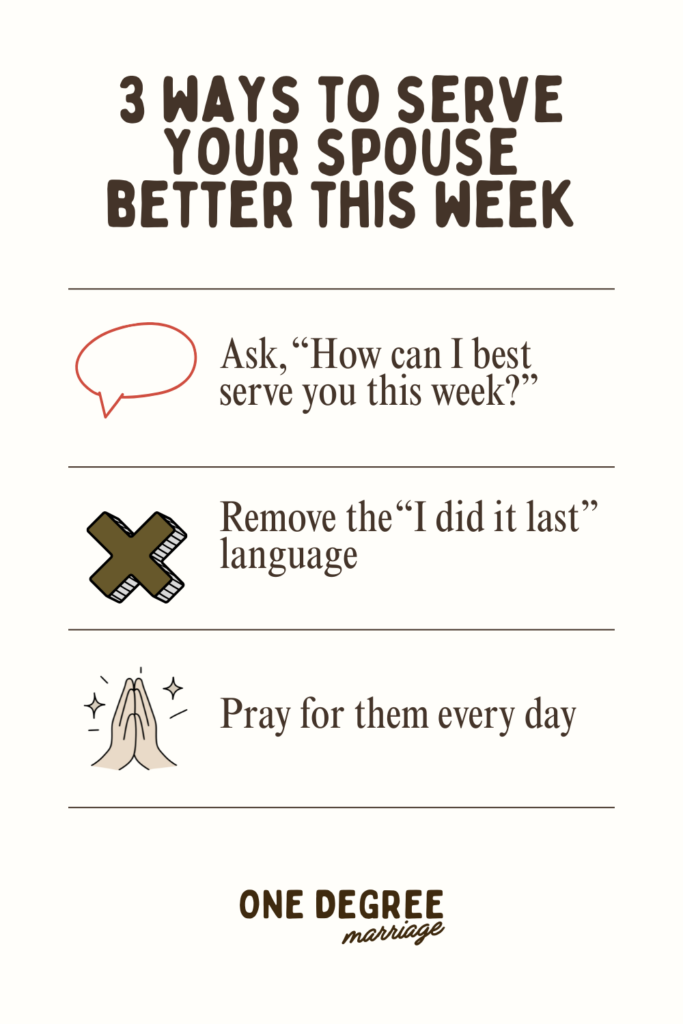
- Three practical, this-week action steps to start cultivating a servant’s heart
🎧 Listen Now:
[ Apple Podcasts ] [ Spotify ] [ YouTube ]

Top Takeaways From This Episode
1. You’re Probably Keeping Score (Even If You Don’t Mean To)
It rarely starts with selfish intent. It’s the casual, “I cooked, so you clean up.” The bedtime trade-off. The diaper tally. On the surface these feel like fair systems — but underneath, they quietly shift the purpose of your service. You stop serving out of love and start serving to earn. That’s when marriage loses something essential.
The Action Plan:
- Notice the language you’re using. Are your requests rooted in what you’ve already done?
- Swap the tally-based ask for an honest one. Instead of “I did it last night,” try “I’d love to get a workout in — would you mind doing bedtime?”
- Let the language change lead your heart — not the other way around. Outward to inward works too.
Mistake to Avoid: Thinking that because your intent is innocent, the impact doesn’t matter. The subtle scoreboard damages intimacy whether it’s conscious or not.
2. Service Has to Start With You — Not Your Spouse’s Behavior
The moment you hear “out-serve your spouse,” the enemy of your marriage will immediately redirect your gaze outward. You’ll think about what your spouse is or isn’t doing. Nathaniel admits it plainly on this episode — even in a healthy marriage, the reflex is to ask: “But does my spouse actually do this?” That reflex is the whole problem.
The Action Plan:
- When you catch yourself thinking about your spouse’s failures, redirect to your own. Ask: “How can I serve them better this week?”
- Focus inwardly on your own flaws and growth edges — not theirs.
- Remember: the Son of Man didn’t come to be served, but to serve. Jesus didn’t wash feet expecting foot-washing in return.
Mistake to Avoid: Waiting for reciprocation before you serve well. That’s not servanthood — that’s a transaction.
3. When You’re Doing All the Serving and Nothing Is Reciprocated
This is where the episode gets real. Xan and Nathaniel acknowledge the weight of serving a spouse who genuinely does not reciprocate — and they don’t offer a tidy fix. What they offer instead is the gospel: you serve because of who you’re serving for, not who you’re serving with.
The Action Plan:
- Remember who you’re doing it for. Your service says something about the God you believe in and the gospel you follow. It is not invisible — God sees it.
- Bring it to your spouse first. Use the “I feel / I’d like” framework to communicate what you need without accusation.
- If that conversation doesn’t feel safe, bring trusted biblical community into it — a pastor, mentor, or friend who will point you back to scripture. You are not called to suffer in silence.
Mistake to Avoid: Isolating and enduring alone. Doing it unto the Lord doesn’t mean doing it without support.
Resources + Free Download
One of the questions Xan and Nathaniel ask every single week in their Weekly Marriage Meeting is: “How can I best serve you this week?” If you want that prompt — and the full meeting structure — grab the free template below.
👉 Free Weekly Marriage Meeting Template
Want to take it further? The Weekly Marriage Meeting Journal™ gives you a full year of guided questions to keep your marriage growing—week by week, one degree at a time.
About The One Degree Marriage Podcast
The One Degree Marriage Podcast is hosted by Xan and Nathaniel, a husband-and-wife team dedicated to helping couples build deeply connected, intentional marriages — one small shift at a time. The show covers everything from communication and conflict to faith, finances, and the rhythms that make a marriage thrive.
New episodes drop weekly. Subscribe wherever you listen to podcasts.
You don’t have to figure marriage out alone. At One Degree Marriage, we help couples build intentional connection one small shift at a time. Start with our free Weekly Marriage Meeting Template — or grab the full journal to go deeper.
Read full transcript
One Degree Podcast (00:00.59)
What is up one degree fam? What is up fam? Welcome back to the comfy cozy virtual leather couch. So happy that you are joining us here today. Yeah, I was going to say on this rainy day, but it might not be rainy where you are. It is at the time of recording sunny and 75 degrees. But yeah, if you hear a little pitter patter of rain on our roof, it’s kind of peaceful when you’re sitting here, but yeah, yeah, it’s a good work from home day for me.
But cozy day. That’s for sure. one of the classic, it’s like 38 and raining right now. it’s one of those classic to step outside. That’s why I say those days are the perfect work from home. Cause when it’s sunny and beautiful, I’m like, I don’t want to be inside working from home. Anyway. Yeah. All right. So what are we talking about today? Today, we were talking about what does it look like to seek to out serve your spouse? Because I just, right off the bat, I want to cast this image for you or this picture for you.
of what if both you and your spouse, when you woke up in the morning, you woke up with this mentality of I want to out serve my spouse. Because I ultimately think that what the best marriages look like is when both spouses put each other’s needs ahead of their own. That’s when marriage is at its finest. That’s when marriage is at its best. And I think a lot of us, when we hear that of what does it look like to
wake up and say, I’m gonna try to out-serve my spouse today. We hear that and we immediately go into this like reason why we don’t, this but of, but my spouse doesn’t appreciate what I do do for them. Or, but I do most of the work in our marriage already. Or, but if my spouse had this mentality, then I would also have this mentality. Because I think for me, if I’m being completely transparent, I would say that we have an overall healthy marriage.
And when I think of this, the immediate, it’s my flesh for sure. But if I’m being completely honest, my immediate thought when I say this is like, I wonder, like, does Ann really do that though? It’s like the focus immediately gets shifted onto you instead of me. And the purpose of this question is to cause inward reflection and conviction that ultimately it’s not based on your spouse. It’s based on you. What does it look like for you to wake up and have this mentality of I want to serve my spouse?
One Degree Podcast (02:25.55)
today and I want to serve them well because I think ultimately we desire in our flesh to be served rather than to serve. Yeah. Or at least to like have a reciprocal level of service. If I serve you and that feels good, but I also not necessarily from the same person. I don’t know. I just think in life, we also kind of expect that in return.
But it is so true. think of like there are these small little ways and even if you have like the healthiest of marriages I think when we go through these small little examples of ways this can creep into your marriage you would say shoot that that is true, you know of hey Baby just pooped. I got the last one you got this one or you know, hey, I cooked dinner So you got clean up tonight or I did bedtime last night Can you do bedtime this night? You know tonight or something like that and you know on the surface these
These aren’t crazy requests, right? These are like natural, hey, I did it last night or I did this, so can you do that? But that’s not necessarily how marriages are intended to operate. And I think there’s something, I’m flushing this out while I talk, so we’ll see where it goes. But I’m thinking that the issue there is the, like, I did this last night, that initial statement of.
the reason I’m asking you to do this is because of something I’ve done. Like it could almost the same thing. I’m thinking, okay, bedtime. That’s a common thing we say like, I laid down with them last night. You can lay down with them tonight. Not necessarily maliciously, just kind of like, okay, we’ll keep it even. Whatever each of us gets our time to do whatever during that time. But it’s like, what if it were just, hey, I want to do this, this, like I want to do this right now. So could you do this? Not like I did this for you, but like.
hey, I’d really like to finish cleaning the kitchen. like, hey, I really need to get this work thing done. like, whatever it is. Like just being honest about what that is versus having it be rooted in this. It’s not a record of wrong, but I’m thinking that idea of like a record, like a tally. Yeah, it is. It’s like this subtle scoreboard. And ultimately you’re not doing it. It turns into, I do tax, not because I love my spouse or love my family or because I want to serve them. It turns it into, I do it so that.
One Degree Podcast (04:39.362)
they will then do something for me or I do it so that I don’t have to do it tomorrow or I don’t have to do it later. And I think ultimately, again, there’s not something this crazy malicious thought process or intent behind it. But as Christians, I believe that we should model our lives after Jesus. And you look at Jesus, you know, the Son of Man did not come to be served, but to serve and to give his life as a ransom for many. You know, Jesus didn’t give his life so that
then when the time came, other people would then give their life for Him. Jesus didn’t, you know, wash their feet so that later they would wash His feet. You know, there was this self-sacrificial love that Jesus had that should be demonstrated through our marriages of, do this in order to serve my spouse. Nothing else. To serve my spouse, to serve my family, to show my love for them, not out of, I can, they’ll do it tomorrow night, or…
you know, then I’ll get out of having to do this later or something like that. So I think kind of what I’m saying with that is yes, the person doing the thing that should be the goal of like that purity of heart and purity of intention. And then also the acknowledging the power of words when we’re asking, like when we’re asking to be served ultimately, when we’re asking for something for our spouse to serve us in some way, acknowledging the power of words of like, even if it’s not this, like you said, this malicious or deep down like,
scoreboard, whatever, it’s just a subconscious thing. Well, that’s perpetuated by the words of like, hey, well, I just did this. So like removing that mentality from your vocabulary, it’s kind of like outward in, like start from taking it out of your vocabulary and then that’ll start uprooting those subconscious beliefs ultimately. I think that’s a good transition to how do we cultivate this? How do we do this? And I think first of all, it starts by focusing inwardly on yourself. I realize that I’m almost contradicting what you’re saying.
But you gotta think about yourself more. No, I’m kidding. What I’m saying is immediately when this comes to mind, if you’re spout, if you go, but I wish my spouse did X, Y, and Z. And then it would make it easier for me to do this. That’s the wrong mentality to have. Focus on your own flaws. Focus on your own flaws. Focus on the own ways that you can grow. Focus on how, Hey, what does it look like for me to serve my spouse better? And then like Zan said, start part of that is removing that language of, Hey, I did.
One Degree Podcast (07:05.438)
I changed the last diaper, can you get this one? I did bedtime last night, can you do this? I cooked dinner, so can you clean up? You know, and instead if there is something that you want to do, it’s, hey, would you mind cleaning up so that I can work out? Or would you mind cleaning up so that I can go take a shower? You know, something along those lines. It’s asking a request. It’s not basing it off of the fact that you did something. own merits, exactly. not earning, kind of purging that idea that you’re earning.
some right to be served and more setting this, like it’s okay to ask to be served. That is marriage. And obviously you should be seeking to serve too. But I think, you know, I think it’s. That’s really good. It just came to me. No, but I really liked that. Like we almost view it as I do something and because I do something, I am earning the right to be served later on. Yeah. I think that’s a deep down belief that we have. Yeah.
Yeah, and I think it’s in all the conventional marriage advice, Of marriage needs to be 50-50 and all of those kind of, you know, generic worldly marriage advice that is kind of expressed in different ways throughout those sayings. Yeah, for sure. And so again, it’s like, we look at, in general biblical wisdom, we do want to work from the heart out, but I think there is also…
some wisdom to working outside in, like I said, of just like an easy fix is changing the words you say, and then waiting for your heart to match that. It’s kind of like, you know, work on both at the same time somewhere you’ll meet in the middle and things will be better. anyway, what would you say to someone that’s like, really like, I’m trying to do this, but I get no reciprocation at all from my spouse. Like, I feel like I’m just being taken advantage of because they’ll do literally nothing.
and I’ll do everything. I don’t know. It’s hard. Anytime you put me on the spot with these questions, it’s just always hard because obviously I feel a lot of empathy. Empathy is the one that you have to experience yourself, right? Whatever. I empathize with that, I guess. I have empathy. No, empathy is where you have to experience for yourself. I empathize instead of changing from empathy to empathize. to not be weird to say sympathize.
One Degree Podcast (09:25.068)
Anyway, I feel the heaviness of that. can’t imagine serving day in and day out. It’s one thing when it’s for a child. It’s one thing when it’s for a child with special needs or an adult with special needs. Somebody that you can, in your mind and heart, believe they don’t have the capacity to reciprocate this. I feel like that’s a little simpler. It’s got hard to it, but it’s a little simpler to be self-sacrificing.
When you know that somebody has the full capacity to reciprocate if they desired to, and they’re just not, that is hard. And I acknowledge that. I think that is the power of the Holy Spirit. Like that would be not to give a cop out answer, but I think that, I mean, that Jesus like had the capacity to continue, not the capacity. I don’t want to get into like things that can be theologically, whatever, but Jesus continually gave of himself with knowing that people would
have the capacity and just simply would not reciprocate, you know? And that’s our, that’s our standard. And so I don’t think anything less than that is good advice. You know, I don’t think that anything less than that, I maybe conventional wisdom would say, well, you got to draw a boundary like of, well, you just don’t. Yeah. I mean, there may be a, some wisdom to not being taken advantage of. Like this, this is when this podcast gets dicey of like,
We’re not speaking into every situation. And I want to recognize that we don’t speak into every situation. And I would give twofold is the first thing I’d say, remember who you’re doing it for. Because ultimately, if you were a Christian, you’re not serving your spouse again, to earn some way to have them serve you. You’re not serving them to make them love you more. You’re not serving them, you know, for any other.
earthly reason because in the way that you treat, in the way that you serve your spouse, in the way that you interact with them, it says something about the God that you believe in. It says something about the gospel that you follow. And so you need to remember that you serve them out of a love for God. Just like… Well, and for heavenly reward. Yeah, for heavenly, you know, and God sees that and God sees you in that even if your spouse doesn’t. And I think it’s important to remember that and that’s where you have to start. It’s just like that whole idea of
One Degree Podcast (11:46.71)
you know, in everything that you do, do it unto the Lord. When you go to work, work with excellence, even if your boss doesn’t see you, it’s that whole, it’d be something similar of, hey, it’s really hard for me to do my best at my job because I feel like I’m never rewarded. I feel like I’m never seen. And I empathize with that. or, you know, going down the whole rabbit trail that Dan did, I sympathize with that, or I feel that.
But ultimately I don’t work to get notice from a boss. As a Christian, I believe that I work and do, I seek to do excellent work because I’m working as unto the Lord ultimately. And so in your marriage, that would be the first thing I would say is remember who you’re doing it for and that ultimately you’re doing it in the power of the spirit. And it says something about the God and the gospel that you believe in. And this is just a tiny, I think that is all definitely the meat of what’s important in that. I think
to it says, it’s a testimony of your faith to do to.
do acts out of the belief that God is. We talk about that sometimes of like, but if I’m doing it for heavenly reward, like, isn’t that just as bad? It’s just like rewards in heaven versus rewards here. And it’s like, well, that takes faith to believe that that is going to happen, like that that’s true and that that God, so, and God is glorified in us having that faith. That’s just something, that’s like a conceptual gap that I had for a while of like, well then, because I am an achiever and I want,
I want earthly achievements. But then if I just kind of placed those into wanting heavenly achievements, I was like, well, this is just taking, this is just as problematic. And I feel like you kind of helped me through that. Yeah. Because I think the Bible, if that were the case, then the Bible wouldn’t use so many illustrations of heavenly rewards. You know, we see that littered throughout the new Testament of we, the work we do here on earth will be recognized by God, either good or bad. And like,
One Degree Podcast (13:46.498)
we, you know, ultimately, I want to be careful here because I’m not saying workspace salvation. We are saved based on our faith. But you see even in the parable of the workers. Yeah, even the parable of the talents, right? The person who was entrusted with five, five will receive five more. The person who was entrusted with 10 and was faithful receive 10 more, you know? And so I think that the work that we do here, if we have this mentality that we are working unto the Lord,
and we will be recognized by Him one day, I think that’s okay, I think that’s fair, I think that’s biblical and within the bounds of scripture. And so that’s what I would say is number one, remember who you’re doing it for and it speaks to your faith that you have in Jesus. And then number two, and I talk about this often, but doing it for God doesn’t mean that you’re doing it in isolation. And so if you have this,
you know, man, I am really struggling or having difficulty in the fact that I am primarily serving my spouse and I don’t feel that reciprocated and you don’t feel like you’re in a safe place to be able to bring that up with your spouse. Number one, I would say if you have a good marriage, you know, like your spouse is a good person, healthy person, you’re not worried about abuse that you should start with bringing that up with your spouse of, hey, I feel neglected or I feel isolated.
because I feel as if I take on the burden of the chores or the parenting or whatever it may be. And I feel like I do it alone. Is there any way that we could do it together or come up with a plan to to have it be where we’re both doing this as a married couple? know, Zane and I have talked about the I feel I’d like connection framework, you know, so that I feel isolated or I feel alone or I feel like I’m doing most of the housework. I would love if, you know, X, Y, Z.
Is there any way that we could come to that? You know, so I’d say start with your spouse. But if you’re not in a place where you feel like, you know, you can have that type of conversation with your spouse, that’s where it’s the important of biblical mentors, pastors, friends that are going to point you back to scripture that you’re able to talk through those concerns and those issues with. Because we are not called to suffer in silence as Christians. And I think it’s important to remember and to know that. And that’s the type of conversation that you can bring and have.
One Degree Podcast (16:05.718)
with trusted biblical friends, pastors, mentors, everything like that. Yeah, that’s good. Yeah. And that’s, I admit that it’s hard because I know it’s hard for me. And that’s where I go back to what Zan was saying earlier of I feel the weight of that because I think that you do have this mentality of trying to love me and serve me and all of this kind of stuff. And yet I still, when I hear this idea of, waking up,
and seeking to out serve your spouse, my immediate thought goes to, well, why can’t Dan do that? And, I mean, it’s a fair thought. I’m pretty selfish. What? Yeah. I mean, we both are, right? But that’s where it’s like, okay, so I recognize how hard that would be to hear for someone who. Yeah. We’ve got to generally, like we are, we’re pulling our weight, we’re pulling each other’s weight, like we, you know, and it still feels so, yeah. Like it’s a hard statement to hear.
And we recognize that and that’s where we talk about it’s the importance of the Holy Spirit. It’s the importance of remembering who you’re doing it for. It’s the importance of prayer. I would say that would be number three, even though it should be number one, you know, praying for your spouse, praying that their heart would be softened, praying that the Lord would give you the strength to serve them well and to seek to continue to have that mentality. Like there’s so much to be said about the power of prayer there.
So yeah, I think that’s just… I don’t know. Whenever we have these conversations, like in life, on the podcast, whatever it is, I’m always just like, man, this is where it’s such good news to be a Christian. Yeah. Like, I know that’s so simple, but sometimes the simplest truths are like the most profound and life-changing. just… Amen. I mean, truly, what? Just like the simplest truth is so life-changing and profound is what you were saying. But I was saying…
It’s so good to be a Christian. was like, amen. Well, because I was even thinking, I’m like, okay, there could be some podcast episode out here about like how to serve your spouse. And then apart from the truth of the gospel and what that means for life as a Christian, I don’t even know what they’d keep saying because you get put in these, if you, if you asked somebody that was not a believer, like, what do do if it’s like, this would have taken a totally different path of like boundaries and
One Degree Podcast (18:22.286)
all of these. And again, I’m not saying I’m not hating on boundaries. I’m just saying like it would have been all this worldly wisdom of like, okay, and then if you try for six months and you and it’s really just like lesser for your, it’s really lessening your mental health and stuff. And it’s like, well, then that’s probably grounds for separation and divorce. And it’s like, I just feel like it takes a totally different path of advice if you’re not a Christian, but we have so much. It’s not even like, oh, well, we just didn’t do it because we’re a Christian. have the Holy spirit. It’s like, we can believe that God will change our spouse’s heart. Like
The prayer, like you said, prayer isn’t an afterthought. we, that is our first step. We can pray for ourselves. We can pray for our spouse. We can, and that is so much more powerful than anything else. I don’t know. It’s just like- And we can believe that even if our spouse’s heart isn’t changed, that our actions will be recognized and rewarded by God. Yeah. And we’ll set generations of change because if you, I’m thinking if kids are in the picture and your kids see
mom or dad who is serving Christ and serving this unreciprocating spouse, like that is a very living testament of the gospel to them. Sorry, I didn’t mean to interrupt, but it is so true because my immediate mind goes into like Hosea, right? Where God is continually running after his people even though they’re rejecting him. And you see that all throughout scripture of
Jesus dying for his disciples, even though that they all scattered and they rejected him, you know, after he died. And, you know, ultimately we see this throughout the New Testament. And so ultimately, even though how difficult it is, that could be such a beautiful picture of the gospel too at the same time. It’s just like such a purposeful life, even in the hard and suffering even, you know. Yeah. So then kind of after that,
How do you do it even when you’re not in the mood, even when you’re not feeling generous, even if it’s like you’re tired, you’re exhausted. I’m setting you up for your T ball statement or not your T ball. Like I’m setting you up with a soft ball so that you can the Holy Spirit. No, no, no. What’s your statement that you always love to say? we do hard things over and over until we die. So inspiring. Put that on a billboard or put that on a T shirt.
One Degree Podcast (20:38.542)
I mean, if you’ve been around here, you know I mean it. do, life is doing things that your flesh does not wanna do over and over. Like that is, the reason I think this, I think the original statement came from when our foster daughter was here. I think that’s the first time I said it, maybe. Yeah, or like when you coined it. Yeah, maybe I was like, okay, you know, I do believe this, but because she was complaining about something, she was teenager.
It’s made about homework or something like that. I just don’t want to go to practice. don’t want to, it was always, I don’t want to do this. And I remember just being like, you know, I don’t want to wake up and first thing in the morning have to take care of everyone. I want to wake up and I want to read a book and make coffee. like my entire day from the moment I woke up, like open my eyes is doing things that honestly I don’t want to do. And I remember being like, well, that’s depressing.
I’m like, that’s life. I was like, no, because you find joy in those things. And it’s like, I do want to serve my kids. I love my kids. But do I want to serve them the first thing when I wake up and somebody’s crying? Or do I want to serve them every single day? Yeah, every single day, every single moment. Is that something that I just genuinely have the desire for in that moment? Most likely not, if you ask me at any given moment. Right now, the thing that sounds so nice,
is making a cup of afternoon coffee and getting in my bed and reading a book. Will I do that? Absolutely not, because that’s not what I have. Like that’s not what needs to happen today. Anyways, so it’s like same thing. Okay. Drawing it back in. Cause I could go on a whole tangent. It’s I mean fitness. Okay. I said I was going to go on a and then I went into fitness, but it’s like a very few people. It’s very rare. I love working out. It’s probably my favorite hobby because it’s probably my only hobby to be honest, but I love it. But it’s never like,
I’m laying in bed and I’m like, I, it’s rarely like, just want to like go sling some weights around. Like I just want to get really sweaty and out of breath. Like, no, I want the feeling after I do all of those things, I want the strength that comes from doing those things repeatedly. But like doing the act initially is not enticing. You have to, you have to do the things that you don’t want to do. So serving your spouse, it’s like, no, I don’t want to have to take care of another person. I don’t want to have to,
One Degree Podcast (22:59.758)
Like think of another person’s schedule. I don’t want to have to think of meals Or like whatever I don’t I don’t want to take any my flesh does not want to take anything about your existence Consideration that sounds so bad, but it’s like get me out of the picture Well, no, but it’s like but I get obviously there’s so much joy in that too. It’s just like in the moments It’s I don’t think it’s like the it’s not the path of least resistance taking care of yourself and your own desires only
is always going to be what sounds best. so, yeah, I think that practically speaking, it’s, and that is a, that’s a muscle that you, that you build. You get the reps in of it’s, I mean, it’s again, it’s not like this conscious thought that I have all the time. I’m like, don’t want to do this, but I’m going do it because it’s just second nature. It’s called being a disciplined person. And the more you practice your discipline muscles,
more second nature it becomes and you don’t even think about it anymore. And you might even gaslight yourself into thinking you actually enjoy those things. I would just add that I think that what makes it also really difficult in our culture is that everything, no, I shouldn’t say everything. This is a broad statement, but I think we have been painted this picture that we should do things that bring self enjoyment. Like we are very gluttonous. we have one life. Why would we not live it to our
greatest enjoyment. we have a, we have a right to pursue our self enjoyment at all costs. what made me think about it was it’s funny cause bringing it back to fitness, what you were talking about. So I normally have a screen time limit on my phone where I have 10 minutes of Instagram and social media or Instagram and Facebook. And those are my two
modes of social media and I only have 10 minutes and then timer goes off and I can’t access it the rest of the day. And a friend knows a password. So I don’t even know the password. can’t, I can’t get more, you know, just press the like, get more minutes or whatever it is, or enter screen time password. so last night we had taken off the password. had the friend take off the limit on Instagram when we had the hacking. If if you haven’t been around, we two months ago,
One Degree Podcast (25:21.492)
our account got hacked and we’ve been trying to recover it. And so it was constantly being on like on Instagram to be on the meta verified chat. Yeah. That’s the context. That’s the context of it. So I had gotten so used to like really, I didn’t really go on Instagram in the first place. I just went on Facebook and so it was more important to have Facebook have a time limit. Instagram didn’t really matter, but like three days ago I realized I was like, I can just go on Instagram and you know, spend as much time there. And I spent like
30 minutes just in one sitting scrolling after the kids had gone to bed. And I was just like, oh my gosh, like I can’t believe where the time had gone. And then last night I was going to go for a run and I was on Instagram for like 25 minutes after the kids had gone to then I wasn’t going to go for a run anymore. I was like, you know what? No, I’m going to do it. I’m going to put it away and go for a run. But it made it so much harder to be disciplined, not having that limit in place because it is so much easier to produce, to
pursue self-indulgence in so many different areas unless we aren’t disciplined in our habits. And I think that ultimately I was so thankful afterwards that I just put my phone down and gone for a run, even though it was 36 and cold and dark outside. But that’s part of what life is too. Like there is so much more growth that comes from the perseverance of doing hard things that we miss out on.
when everything is easier, when we pursue self-indulgence at all costs. And so I would say similarly, when it comes back to this idea of serving your spouse, there’s so much growth that comes from having this mentality of seeking to others, specifically seeking to serve your spouse that we miss out on when we’re just constantly trying to figure out how they can serve us better. For sure. All right, let’s bring it home. What are some ways that we can do this this week?
Yeah, I would say that the first thing is, and if you have gotten our weekly marriage meeting template, or if you got the weekly marriage meeting journal, you know that this is a question that we ask every single week in our weekly marriage meeting. ask, Hey, did I serve you well last week? How did I serve you well last week? how can I serve you? How can I best serve you this week? We actually in the last year tweaked that to be, can I best, because it is different from each week. Um, we have to kind of, so this gives us a chance. Yeah. So ask that of your spouse.
One Degree Podcast (27:40.451)
And then when you’re answering this, gives us a chance to step back, look at the week and really evaluate like, what do I most need this week? What can my spouse come alongside? And then hear that in your spouse too. Hear that from your spouse too. I’m trying to think of an example of what it was for us this week, but I don’t know if we’ll be able to think fast enough. I remember for yours, it was specifically like help with
Your desire was to be in bed by 930 every night this week. Was it this week? Yes, that was this week. this has been my week of focusing on that. On that. And so your goal was like, if I could just help making sure that the house is tidied, cleaned up, ready to go so that it allows me to be in bed by 930 this week. Yeah. Yeah. So that was yours. Mine was you being kinder in your responses to me. That’s a on rotation one.
My words. Or even the tone of words. Right before starting. It’s ongoing process of sanctification in my life. Right before starting this podcast, I walked into the house and Zan was downstairs and I was like, Zan? And she was like, what? Context. I was cutting up meat, listening to my worship. I was getting all this stuff ready to make a stew on my lunch break. And then I was like, oh crap. I saw his carpool. And I was like, oh crap, we got to get the podcast recorded.
I need to run down and get the microphones. And so I run downstairs and I was like, he’s going to walk inside the house and he’s going to act like he doesn’t think I’m home because I’m not upstairs right now. And so I was like, he’s going to be calling out my name. And literally as he says that, he’s saying, I was like, what? Cause I was like, it’s literally exactly what was going through my head. And then he was so mad. Well, no, I was just like,
I just felt like it was an uncalled for tone. And it was, but then if you’ve been there, you know, it’s like, what do you say besides sorry, sorry, sorry. Anyway, you can tell, see, this is something for us too, that we’re consistently seeking growth in. This is real life stuff right here. We’re not going to hide from the uglier the ways that we have to grow as well.
One Degree Podcast (29:52.643)
But yeah, I think ultimately, and if you aren’t in the habit of regularly asking your spouse this question or having a weekly marriage meeting, maybe it just starts with, hey, I want to love you well this week. What’s one way that I can serve you this week? Or what’s one way that I can serve you best this week? You know, maybe it just starts there. You’re worried about them reciprocating. I think in probably at least 75 % of marriages, I would hope, like if you ask that question and your spouse gave you an answer, they would then ask it in turn. Maybe not, but maybe just start.
there of, I want to love you well. What is one way that I can serve you best this week? And that’s one thing you can do. I think another one would just be to… It’s a long one degree shift. Yeah. No, but I was saying of like ways that we can… That would be the first one degree shift, but maybe you already do that. Maybe it’s part of your weekly marriage meeting. A couple other things that you could do and I would encourage you to do would be remove…
What Zayn was talking about earlier, removing that language of, I did this, so now can you do that? I scratched your back, so can you scratch mine? Language in the words that you say. Just be straight up and upfront of like, hey, I’m just really tired. Would you mind changing the diaper? Or I’m just really tired. Would you mind doing the dishes? Or I just really want to get in a shower or workout or whatever it may be. Just being honest instead of, hey, I did something. Because what comes across when you say, I did this,
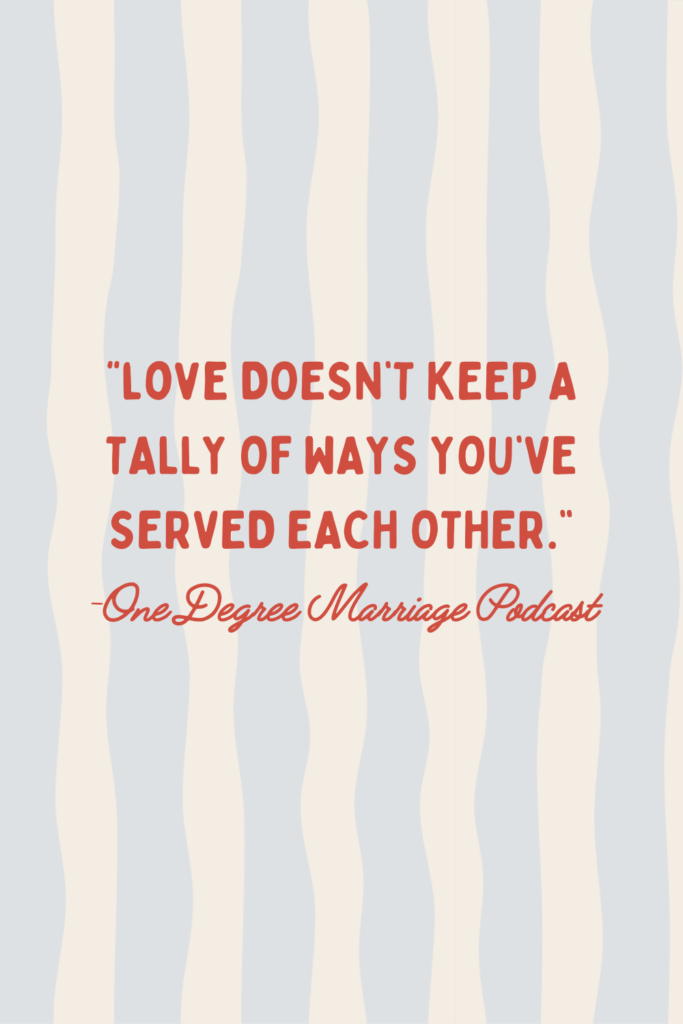
can you do it now? It’s this, you owe me this. I did it before, so now you owe me doing it now. And that’s not the mentality that we wanna have in our marriage. Again, I think it’s not record of wrongs explicitly, but it’s the same heart as that. Obviously, it’s that whole first Corinthians of like, love keeps no record of wrong. Love doesn’t keep a tally of ways you’ve served each other. Yeah, no, that’s very true. And then I would say is number three would be to just really pray for
I the spirit, pray for God’s help. Pray for if you feel like you need a spouse with a softened heart, pray for a softened heart for them. But also pray- You need a softened heart? You need a softened heart, pray for softened heart for yourself, but pray that you would be given the strength to be able to serve your spouse even if they don’t reciprocate. Yeah. And remembering that ultimately what you’re doing is to the Lord, unto the Lord. Unto the Lord. For sure. That’s good. Yeah. All right. That’s all we got for you. All right. Love you, One Degree Catch you next week. Go out and serve your spouse well this week.


+ show Comments
- Hide Comments
add a comment